
Hey hey everyone! I’m back again! Now, picking back up from where we left off…
So, after reading the first blog with the somewhat terrible advice that some writers give out, you may be wondering “But Nova, these pieces of advice can be good if they are in the correct situations! Who knows? Maybe Miss Lisa Henry has the right situations for each of her pieces!”
Which I answer to you, dear reader, the answer is… no.
Now, for the rest of this blog series, I’ll show each one of the issues Missing by Lisa Henry has with examples of how to properly write a story out so that the issues doesn’t exist (Baldur’s Gate 3, Kid Icarus Uprising, Wings of Fire, etc).
Because this is a review that also contains contents from other games, please expect MAJOR spoilers for Missing by Lisa Henry and spoilers for Baldur’s Gate 3, at least for this entry.
Let’s get to the critiquing.
Issue 1: Characters
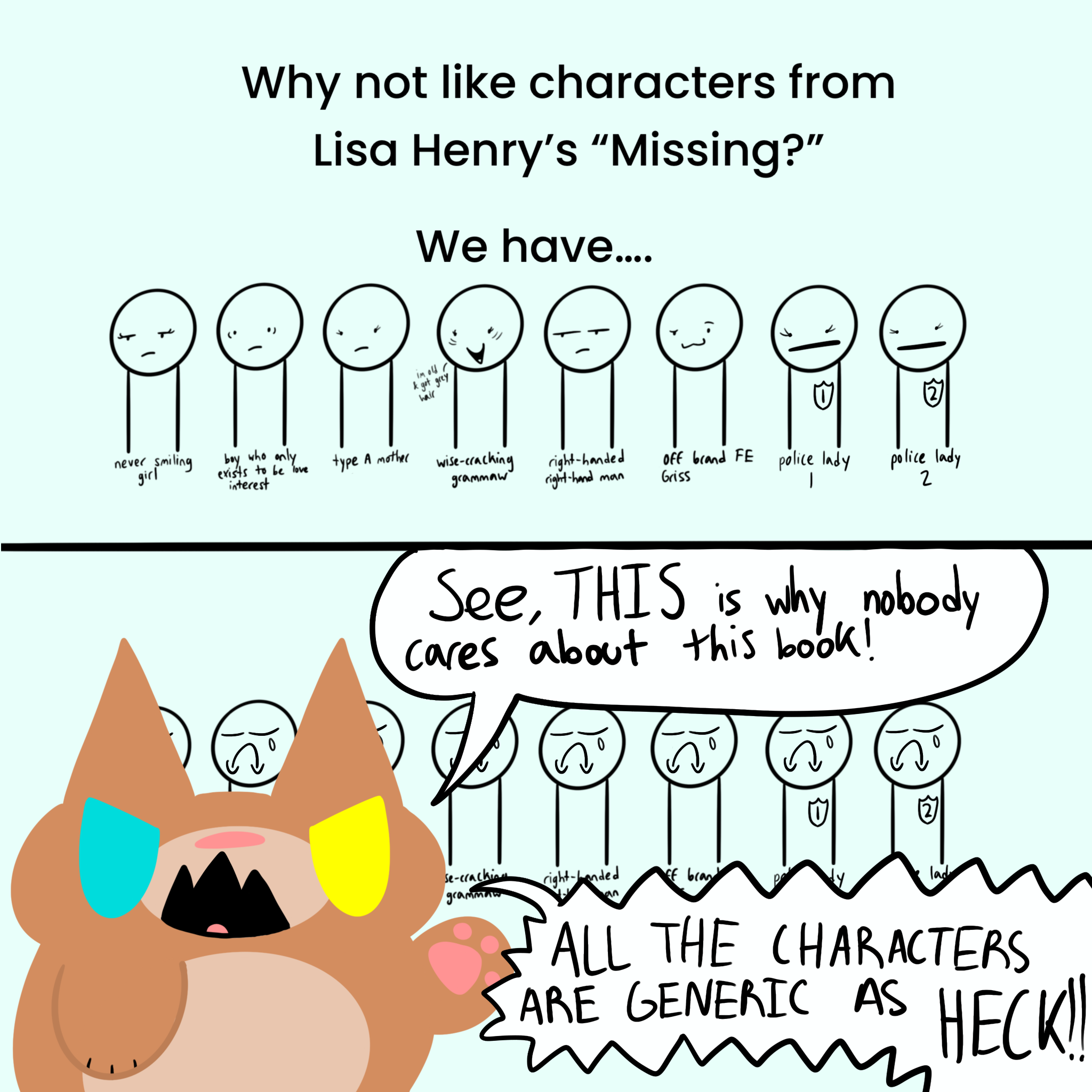
If any of you are familiar with The Our Sunday Project, you may or may not remember how I covered this exact same issue in the Kingdom of Fantasy series by Geronimo Stilton. There are just too many characters to keep track of in the series, and even more to be introduced in each book. Missing suffers the exact same problems.
Yes, we have the main characters:
- Luna (a girl who can see ghosts)
- Monique (Luna’s mom)
- Donna and Savannah (two policewomen)
- Martha (Donna’s wife)
- Pearl (Luna’s grammaw)
- Aura (the main villain)
- Bruce (Aura’s right-hand man)
- Sylvester (Aura’s other (slightly less competent) right-hand man)
- Jhordan (Aura’s reluctant servant)
The list goes on. However, out of all of these characters, Donna, Savannah, and Martha all seem shoehorned into the story. Yes, they do have some part in bringing up some parts of the book’s main mystery (who is Edith Florentine?), but otherwise, they do nothing.
Many of them don’t really have a personality: they can usually be described in a few words:
- Luna is cynical
- Monique is motherly (yes? and?)
- Aura is overdramatic (more about the issues with her in the next post!)
However, unlike the Kingdom of Fantasy, which introduces characters that you only need to remember for at least a few books and nothing more, Missing tries making its characters relevant by slamming as many plot twists as possible.
For example, Monique fades into the background of the story after a while, but then she somehow ends up in the hospital because Sylvester decided to attack her to please Aura.
And right after this, out of no where, Pearl decides to reveal that Monique has magical powers. Something that NEVER is hinted at anywhere in the story, so it doesn’t give you a reason to care about it at all. Not only Monique, but ALL the characters in the book aren’t truly characters: they’re one-dimensional props whose only purpose is to drive the story forward.
Contrast Monique’s portrayal and twist with Astarion, the high elf rogue in Baldur’s Gate 3. From the very start, even from the way he looks, you can tell that something is off about him. His skin is unusually pale, one pair of his canines are sharper in contrast to other elves in the game like Halsin or Minthara, and there are two VERY suspicious punctures on the right side of his neck…
And if you say, “Hey, Nova! So what? This is a video game! We already know what the characters look like! That visual stuff isn’t shown at us in a written book with no illustrations!”
Well, that’s where the actions of the characters come in. In the game, you can find a dead boar in the woods. If you have Astarion in the party, he will question your actions. To paraphrase his words, “It’s just a dead boar! Move on! We have bigger fish to fry!” What really sell this is if the player manages to succeed in an Investigation check to inspect the boar’s body, they can find two punctures on its neck, and then pass another check to see if Astarion knows about it, whining about moving on with the journey.
If the player succeeds in passing the check to convince Astarion of what he knows, he becomes hesitant, a very uncharacteristic trait for a flamboyant high elf as he, before telling the player that the punctures on the boar’s neck means only one thing: it was killed by a vampire. Even though he claims that he didn’t want to tell them because it would scare the player, the way how he seems to withhold that information and the implication that he has encountered a vampire before makes him seem… off.
This is only further strengthened if the player travels through a certain forest in the game to find a monster hunter named Gandrel, who’s looking for a vampire spawn that his tribe has been dealing with for a while. If Astarion is in the party, you can see he’s visibly worried, and afterwards, if the player passes a passive Perception check, the narrator (or the DM in the D&D setting BG3 takes place in) points out how tense Astarion seems, “coiled like a spring.”
After progressing further and further into the game, by taking a certain number of Long Rests, the night will interrupt the player’s bedtime by giving them a cutscene: the player character waking up in the middle of the night with Astarion trying to bite down on their neck.
Turns out, surprise-surprise! Astarion’s a vampire! Who knew?
As you can see, while the reveal about Astarion’s vampirism seems a bit sudden in context, looking back, it explains a LOT of the actions and beliefs that our rogue has! Baldur’s Gate 3 knows something that Missing doesn’t: if you want a twist in a character to work out well, it has to have clues that connect to the twist later on!
The way how Astarion alone contrasts with all the characters in Missing is also different! While the entire personality of ANY of the main characters are only one word, here is the description I’ve come up with Astarion’s personality:
Hedonistic, arrogant, and overdramatic, this elf enjoys chaos and causing it. However, he feels small and desperately wants to find a way how to feel safe and protect himself, and hates doing things he doesn’t want to do.
See how that’s contradictory? You wouldn’t ever expect a character that is full of themselves to also think so little about themselves! People by nature are contradictory, and they have reasons to explain how they feel.
A way how writers can build better characters is to make sentences that follow a “(pro), but (con)” or “(con), but (pro)” pattern to describe the character they’re creating. Here’s some examples with other Baldur’s Gate 3 characters:
Gale: Haughty, but self-loathing.
Karlach: Affable, but reckless.
Lae’zel: Brash, but honest.
However, out of all the characters that I have a pet peeve on in Missing but there is one character that irks me the most: Aura, the main villain. But what makes her fall flat on her face?
Stay tuned!
– Nova Subedi