
Hello everyone!
As most of you may already know, I take Latin classes at my school.
Because I’m in a higher level of Latin, we’ve started doing actual Latin things. So we’re translating actual Latin texts and things.
And we’ve started translating De Bello Gallico.
De Bello Gallico is a series of books by Caesar about…the Gallic Wars. As far as I can remember.
The first book is the one we’ve translated. And in it Caesar describes Gaul.
So I’m gonna summarize the first book. Because I understand it. Strap in everyone.
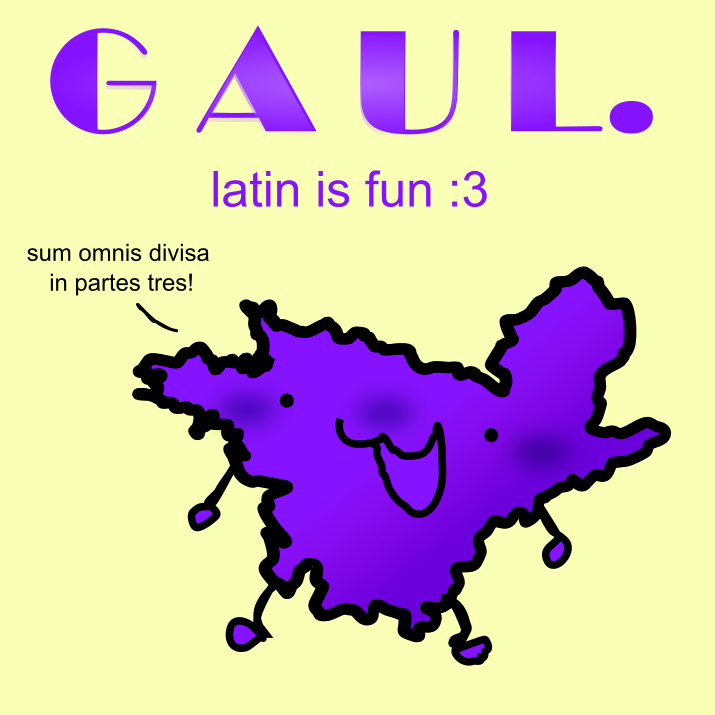
Basically, all of Gaul is divided into three parts (Gallia est omnis divisa in partes tres). Each part is inhabited by a different people. The Belgians live in one, the Aquitanians another, and the Gauls in the last. The Gauls are called Celts in their own language.
All of these parts are different though, because they all have different languages, laws, and institutions.
The Belgians are the strongest because they’re so far from the province. They don’t share the humanity and culture of the province, and merchants rarely visit them. So, they don’t have many goods that make their brains mush.
They are closes to the Germans. The Germans live across the Rhine river and the Belgians constantly wage war against them.
The Helvetians are braver than the rest of the remaining Gauls, becuase they’re always fighting the Germans. Either they’re keeping the Germans from their borders, or they’re invading the German territories.
One part that the Gauls occupy begins at the Rhone River. It’s contained by the Garonne River, the Belgian territories, and the ocean.This part also reaches from the Sequanis and Helvetians to the Rhine River (RHONE is not the same as RHINE), and turns to the North.
The Belgians rise from the farthest parts of Gaul and they extend to the lower part of the Rhine River, in the Northeast.
Aquitania, land of the Aquitanians, extends from the Pyrenees mountains to the Garonne River, and also to the part of the ocean closest to Spain. They’re in the Northwest.
See, Caesar is interesting because he likes to remove words. A lot of Latin does this but there’s a lot in Caesar. An asyndenton is the removal of the word “et” or “and” in poetry, and an ellipsis is the removal of a word to be expected in a space, like a verb.
Latin requires reading carefully and knowing what to do. Which is fun.
There is so much to unpack with Caesar. It’s difficult, but it’s fun. At least it’s easier than Pliny.
Latin is pretty easy with grammar knowledge! We were learning new grammar so it was a bit of a struggle.
But, tips for Latin:
- Find the verbs.
- Check verbs for voices. Active or passive? Is the subject doing the action or is something being done to the subject? (eg. “He threw Billy” vs. “Billy was thrown by him.”) This is VERY important for translation.
- Do you know what cases the verbs take? While many take accusative, some verbs take other cases like dative or ablative as their direct object. When in doubt, Latin dictionary.
- Find the conjunctions.
- Separate your clauses.
- If you struggle with finding out what words are doing, have a list of common case uses at the ready! This is especially helpful with ablative.
That’s all!
I hope you consider taking Latin. And if you do, I hope these tips helped you!!
Bye bye :3